A walkway is the first thing a guest steps on and the last thing they remember — and if yours is cracked, uneven, or just a worn dirt path to the door, it quietly works against everything else you’ve done to the house. A new concrete walkway in Rochester, NH is one of the most affordable, highest-impact upgrades a homeowner can make: it sharpens curb appeal, removes a trip hazard, and gives you a clean, durable surface that shrugs off New England winters. After more than 10 years pouring concrete walkways and sidewalks across Rochester, Dover, Somersworth, Durham, Farmington, Barrington, and the surrounding Strafford County and Seacoast NH area, here is the honest, complete guide — real cost, finish and design ideas, and how to get a walkway that still looks right a decade from now.
Why Your Walkway Is the Hardest-Working Surface on Your Property
A concrete walkway does three jobs at once, and most homeowners only think about one of them until something goes wrong. It sets the first impression of the home, it provides safe, all-weather access to the door, and it ties the landscape together into something that reads as intentional rather than improvised. When a walkway is cracked, heaved, or missing entirely, all three jobs suffer — and in a climate like ours, a neglected path doesn’t just look tired, it becomes a genuine safety issue.
The homeowners who reach out to us about walkways usually fall into a few familiar situations:
- The aging walkway that’s become a trip hazard. An older path that has cracked, settled, or heaved at the joints — a real concern for families with young kids or aging parents, and a liability every time someone visits.
- The curb-appeal upgrade. A homeowner getting ready to sell, or simply tired of a dated or muddy approach, who wants the front of the house to finally look finished.
- The missing connection. No defined path from the driveway to the door, or from the back door out to the patio or pool — just grass that turns to mud and erosion every spring.
- The whole-property plan. A new walkway poured to match a new driveway or patio, so the exterior reads as one cohesive design.
Whatever brought you here, the good news is that a concrete walkway is a relatively small project with an outsized payoff. It’s one of the upgrades we most often recommend to Rochester homeowners looking for lasting value, which is exactly why it made our list of concrete upgrades that add value to Rochester, NH homes.

How Much Does a Concrete Walkway Cost in Rochester, NH?
Cost is almost always the first question, so here’s the honest local picture. In the Rochester, NH area, a plain concrete walkway typically runs $8 to $15 per square foot installed, with decorative finishes adding a premium on top. The total for a project usually lands between $1,500 and $5,000, depending on the length, width, finish, and how much site prep the path needs.
| Walkway finish | Typical installed cost (Rochester, NH) | Best for |
|---|---|---|
| Broom-finished concrete | $8–$15 / sq ft | Durable, slip-resistant, best overall value |
| Exposed aggregate | $12–$18 / sq ft | Decorative texture with excellent traction |
| Stamped & decorative concrete | $16–$28 / sq ft | High-end stone or brick look at a sensible price |
| Pavers or natural stone | $20–$40+ / sq ft | Comparison point — the look concrete can imitate |
One quirk worth knowing: narrow walkways cost more per square foot than a big open slab. Forming, edging, and finishing a long, skinny path takes nearly as much labor as a wide patio, but covers far less area — so a 3-foot-wide walkway will price higher per square foot than a 400-square-foot patio pour. That’s normal, and it’s why a small front walkway can still represent real, careful work. The factors that move a real quote up or down are consistent:
- Length and width. The single biggest driver — more square footage and a wider path mean more material and labor.
- Finish. A plain broom finish is the most economical; exposed aggregate, color, and stamping each add a decorative premium.
- Site prep and access. Removing an old walkway, regrading a wet or sloped approach, or hauling materials by hand to a tight backyard all add cost.
- Base and drainage. A proper frost-depth base and the right slope aren’t where you save money in NH — they’re what protect the whole investment.
The pricing logic here mirrors how we break down larger flatwork; if you want the deeper line-item version, our concrete patio cost in Rochester, NH guide walks through the same factors in more detail. For an accurate walkway number, though, there’s no substitute for a quick on-site look.
Concrete Walkway Finish & Design Ideas
“Concrete walkway” doesn’t have to mean a plain gray strip. The finish is where a path goes from purely functional to a genuine design feature, and the right one balances looks, traction, and budget for how you actually use the walkway. Here are the finishes we install most often around Rochester, NH.
Broom Finish Best value
The classic, dependable walkway surface. A broom finish is created by dragging a fine-bristle broom across the fresh concrete, leaving a subtle texture that provides traction when the path is wet, icy, or snow-covered — which matters a lot in New Hampshire. It’s the most affordable option, it’s extremely durable, and it suits virtually any home. If you want a clean, safe, no-fuss walkway, this is the default we recommend.
Exposed Aggregate Slip-resistant
A decorative finish that washes away the top layer of cement paste to reveal the natural stone aggregate underneath, leaving a textured, pebbled surface. Exposed aggregate is one of the best-looking and most slip-resistant walkway finishes for our climate — it hides dirt and wear well, it grips underfoot, and it pairs beautifully with both traditional and modern New England homes.
Stamped & Decorative Concrete High-end look
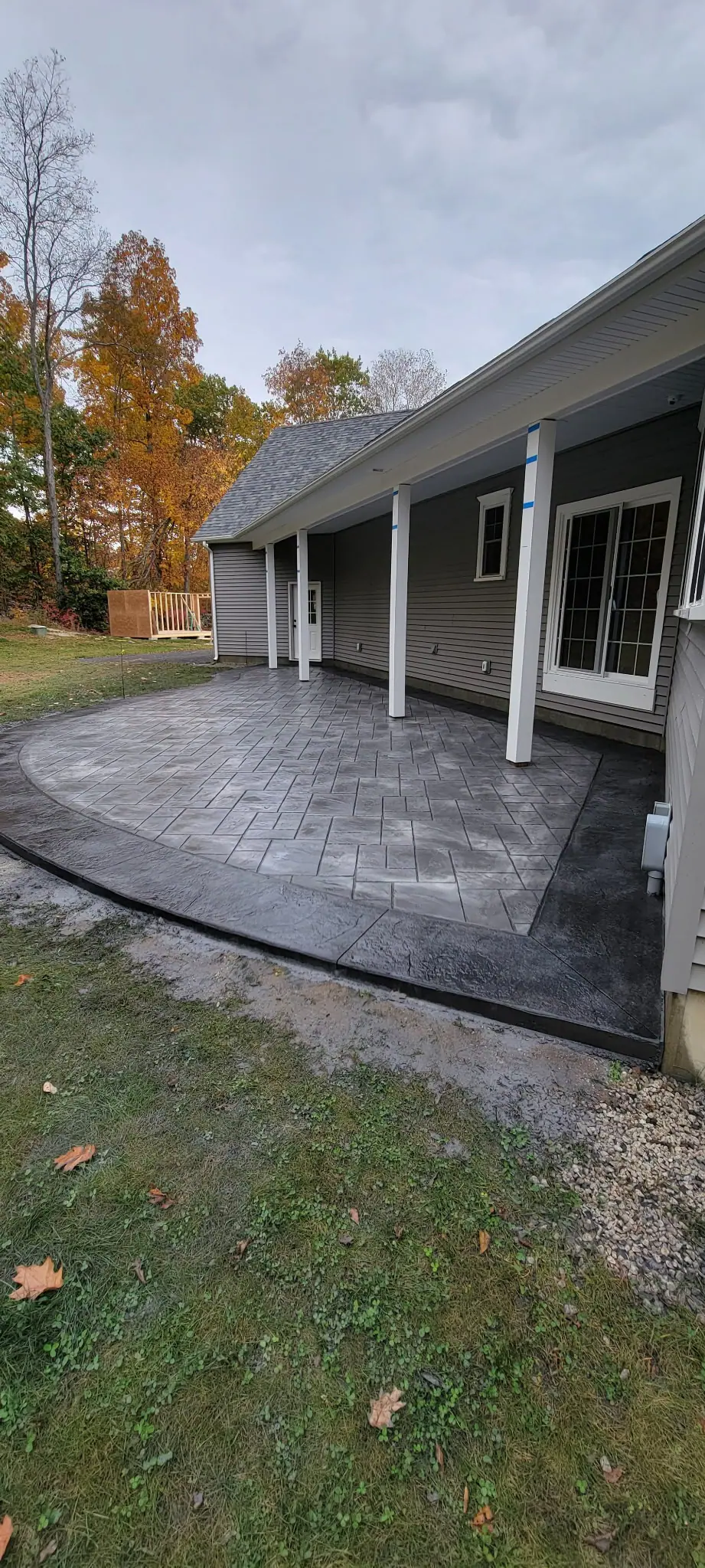
Stamped concrete presses a pattern and color into the fresh slab to mimic natural stone, slate, or brick — the high-end look of a stone walkway without the dozens of joints, the weeds, or the price tag. A stamped walkway can carry the exact same pattern as a matching patio or front entry, tying the whole property together. We cover this finish in depth in our guide to stamped concrete patios in Rochester, NH, and you can see the full range on our stamped concrete services page.
Bordered & Curved Layouts Custom touch
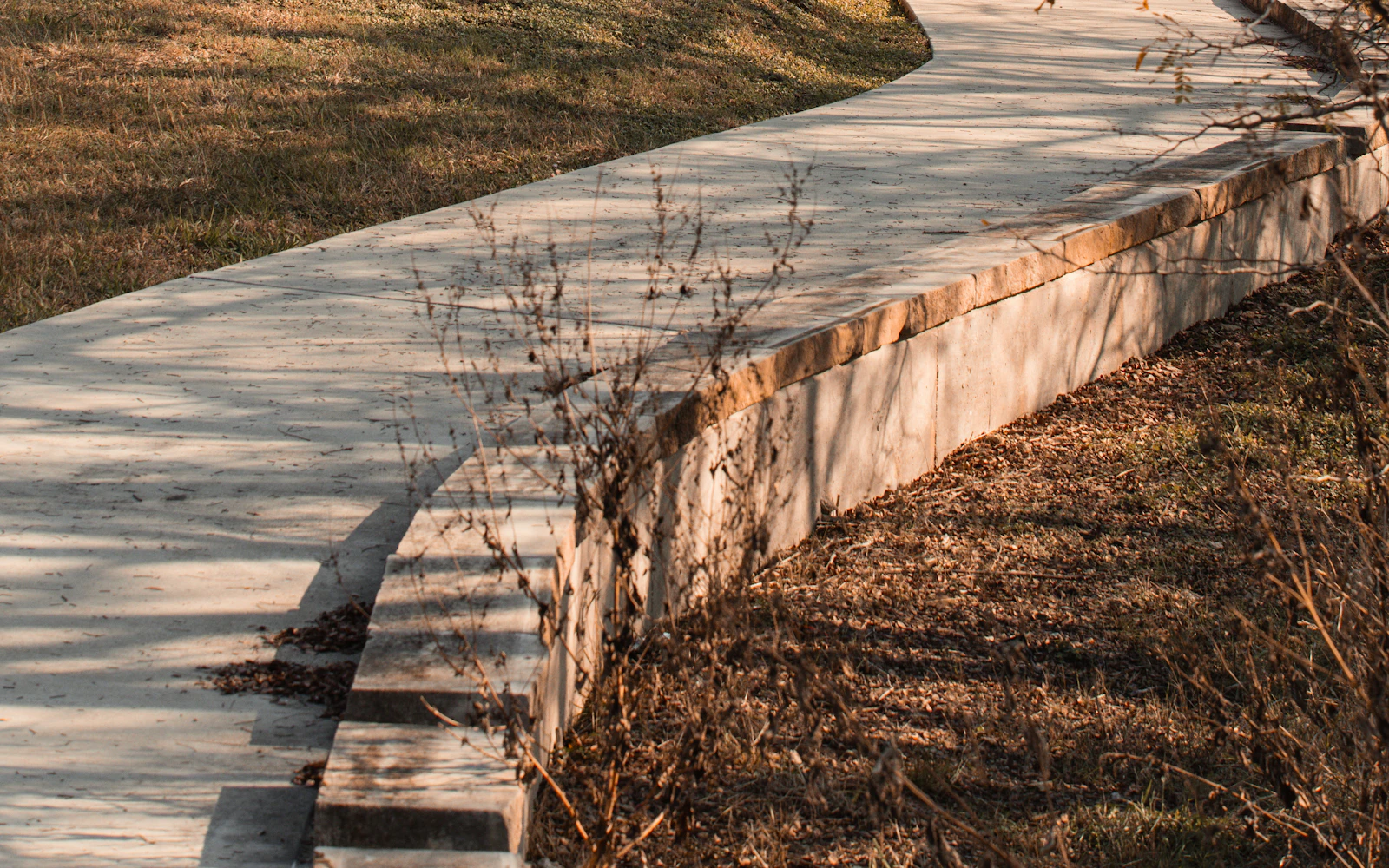
Some of the biggest visual payoff comes from the layout, not the finish. A gentle curve makes a walkway feel more inviting and intentional than a dead-straight run, and a contrasting border — a stamped or colored band around a broom-finished field — frames the path and reads as custom. These are small upgrades with an outsized effect on curb appeal.

Wondering what a new concrete walkway would cost for your home? A quick on-site walk-through is usually all it takes for a clear, written quote and a real design direction. Free, no-pressure estimates across Rochester, Dover, Somersworth, Durham, Farmington, Barrington, and surrounding NH towns.
Concrete vs. Pavers vs. Natural Stone for a Walkway
It’s the comparison homeowners ask us to settle most often, and the honest answer is that all three can work in New Hampshire — but for a typical residential walkway, poured concrete is usually the strongest overall value. Here’s the short version:
- Fewer joints, fewer problems. A concrete walkway is one continuous surface. A paver path is dozens of individual units, each one a seam where weeds can grow and frost can heave a single piece out of line over a NH winter.
- Lower maintenance. Concrete doesn’t need joint sand replenished or weeds pulled from between units. Sweep it, rinse it, reseal a decorative finish every few years — that’s essentially it.
- Better value. Concrete — even with a stamped or exposed aggregate finish — usually comes in below quality pavers or natural stone for a comparable high-end look.
- Where pavers win. Individual paver units can be lifted and reset if the ground shifts, and a damaged unit can be swapped out. If that flexibility matters most to you, pavers have a real edge.
For most homeowners who want a clean, low-maintenance walkway that holds up to New England winters at a sensible price, concrete is hard to beat. We break the whole material question down in more detail in stamped concrete vs. pavers: which is better for New England homes? — and we’ll always give you a straight recommendation for your specific site.
Will a Concrete Walkway Survive a New Hampshire Winter?
A walkway in New Hampshire isn’t judged in July. It’s judged in March, after a winter of freeze-thaw, road salt, and snow shovels. Rochester and the surrounding Seacoast towns see roughly 50 to 70 freeze-thaw cycles every winter — each one a chance for water to seep into the surface, freeze, expand, and pry it apart. That single fact decides whether a walkway is a 25-year investment or a future headache, and it comes down to how the path is built, not the material itself.
- Air-entrained concrete. The right mix for outdoor flatwork here contains microscopic air pockets that give freezing water somewhere to expand without scaling or cracking the surface. This is the single most important spec for freeze-thaw durability — and it’s non-negotiable on every walkway we pour.
- A real base and proper slope. A compacted crushed-stone base sized for frost, graded so water drains off the walkway and away from the house, is what keeps a path from settling, cracking, and heaving. Water that sits or pools under a slab is the enemy.
- Saw-cut control joints. Placed at the correct intervals, these give the concrete a planned place to crack as it shrinks and moves — so any cracking stays in the joint line, invisible, instead of wandering across the surface.
- A quality sealer and smart winter care. A sealer repels water and de-icers and reinforces the surface. In winter, go easy on harsh salts — especially the first winter — and use a plastic-edged shovel to protect the finish. The same de-icer principles we cover for driveways in our NH winter driveway maintenance guide apply to walkways too.
Built that way, a concrete walkway handles New England freeze-thaw for decades. The scaling, spider-cracking, and heaving people worry about almost always trace back to a corner-cut install — not to concrete as a material.

Repair or Replace a Cracked or Uneven Walkway?
If you already have a concrete walkway that’s seen better days, the question is whether to fix it or start fresh. The right call depends on what’s actually failing:
- Hairline cracks and minor surface wear can usually be sealed or resurfaced — an easy, affordable fix that buys many more years.
- An uneven or heaved slab that has become a trip hazard can sometimes be lifted and leveled, or resurfaced, if the base underneath is still sound.
- Badly cracked, settling, or crumbling walkways sitting on a failed or poorly drained base are usually better torn out and repoured. Patching a failing base just buys a season or two before the same problems return.
The deciding factor is almost always the base, not the surface. We assess both the slab and what’s under it on site and give you a straight repair-or-replace recommendation — we won’t sell you a tear-out you don’t need, and we won’t patch over a problem that’s going to come back. For more on spotting and fixing freeze-thaw damage, see our guide to spring concrete repair in Rochester, NH.
Designing a Walkway That Connects Your Whole Property
The homeowners who get the most out of a new walkway think beyond a single path to the door. A little design intention up front turns a collection of separate surfaces into one cohesive, well-planned exterior. A few things worth deciding before the pour:
- Get the width right. A main front walkway should be at least 4 feet wide so two people can walk side by side; 4 to 5 feet feels genuinely welcoming. Secondary side paths can be 3 feet, and a simple utility run can be 2.5 to 3 feet.
- Plan the connections. Tie the driveway to the front door, the back door to the pool patio, and the front entry to the side yard — so there’s a clean, mud-free route everywhere you actually walk.
- Match the finishes. Carry the same finish or border from your walkway into a matching patio or front entry so the whole property reads as one intentional design rather than a patchwork.
- Think about lighting and edges. A defined edge, a gentle curve, and path lighting turn a basic walkway into a feature that looks great by day and guides guests safely at night.
See finished walkways, patios, and entryways across the area on our projects page, and browse the full range of finishes on our concrete walkways service page.
What a Quality Concrete Walkway Install Actually Looks Like
Almost every walkway that fails early fails for the same reason: the visible surface was treated as the whole job, and the unglamorous fundamentals underneath were rushed. After more than 10 years pouring in this climate, here is the standard we hold every walkway to — and a useful checklist to hold any contractor to before you sign:
- Compacted, frost-appropriate base. A properly graded and compacted crushed-stone base sized for New Hampshire frost, sloped to drain water off the path and away from the home.
- Air-entrained concrete mix. Spec’d for outdoor flatwork in a freeze-thaw climate — the microscopic air pockets are what let the surface survive 50-plus freeze-thaw cycles a winter.
- Reinforcement. Fiber mesh or rebar sized to the slab, so the walkway resists cracking under movement and load.
- Correct slope and saw-cut control joints. The right pitch to shed water, with control joints placed at proper intervals so any shrinkage cracking stays hidden in the joint line.
- A traction-first finish. A broom or exposed aggregate finish that stays safe underfoot when wet or icy — never a slick, smooth trowel finish on an outdoor walkway.
- Proper curing and sealing. Controlled curing, then a quality sealer to protect the surface through that critical first NH winter.
A walkway isn’t a one-time purchase — it’s a 25-year surface your family and every guest will use thousands of times. The finish decides how good it looks on day one; the base, the mix, the slope, and the joints decide how good it looks — and how safe it stays — on day 3,650.
Why Rochester Homeowners Choose Patriot Concrete
A concrete walkway is part craftsmanship and part judgment about how a path will live through New England weather, and both come from doing the work, in this climate, for years. Homeowners across the Rochester, NH area choose Patriot Concrete because:
- Over 10 years of local experience pouring walkways, sidewalks, and outdoor flatwork built specifically for New England freeze-thaw — not generic concrete.
- Durable craftsmanship first. We build the base, mix, slope, reinforcement, and joints right, so the finish has something solid to sit on for decades.
- Honest, clear communication. A real written scope, straight pricing, and an honest recommendation — including when a repair beats a replacement, or a different finish fits your site better.
- A genuinely local contractor. We serve Rochester and the surrounding Strafford County and Seacoast NH communities, and we stand behind the work in the towns where we live and pour.
Read more about how we approach the work on our about page, see the full list of finishes on our services page, or browse finished installs on the projects page.
Frequently Asked Questions: Concrete Walkways in Rochester, NH
How much does a concrete walkway cost in Rochester, NH?
A plain broom-finished concrete walkway typically runs $8 to $15 per square foot installed in the Rochester, NH area, with exposed aggregate at $12 to $18 and stamped or decorative finishes at $16 to $28. Most residential walkways land between $1,500 and $5,000 total, depending on length, width, finish, and site prep. Narrow walkways cost more per square foot than a large slab because forming and edging make up a bigger share of a small pour. The honest number for your project depends on access, base conditions, and the finish you choose, which is why we walk every site before quoting.
What is the best finish for a concrete walkway in New Hampshire?
For most New Hampshire homes, a broom finish is the best all-around walkway surface — it’s affordable, durable, and the light texture gives traction when the path is wet, icy, or snow-covered. If you want more curb appeal, exposed aggregate adds a premium, slip-resistant, decorative look, and stamped concrete can mimic stone or brick. The one finish to avoid for a walkway is a smooth, slick trowel finish, which gets dangerously slippery in a NH winter. The right choice balances looks, traction, and budget for how you actually use the path.
How wide should a concrete walkway be?
A main front walkway should be at least 4 feet wide so two people can comfortably walk side by side, and 4 to 5 feet is ideal for a welcoming front entry. Secondary side-yard or utility paths can be 3 feet, and a simple service path can go as narrow as 2.5 feet. Wider primary walkways read as more intentional and high-end, improve accessibility, and are far more comfortable to use day to day. We help homeowners size each path to how it’s actually used before we form it.
Will a concrete walkway crack or heave in a New Hampshire winter?
A properly built concrete walkway handles New Hampshire winters for decades. The Rochester area sees roughly 50 to 70 freeze-thaw cycles a winter, so a walkway that lasts needs an air-entrained concrete mix, a compacted and well-drained crushed-stone base sized for frost, the right slope to shed water, saw-cut control joints, and a quality sealer. The cracking and heaving people worry about almost always traces back to a corner-cut install — a thin or poorly drained base, no air entrainment, or missing control joints — not to concrete as a material.
Is a concrete walkway better than pavers or natural stone?
For most New Hampshire walkways, poured concrete is the stronger value. It’s one continuous surface, so there are far fewer joints than a paver path — fewer places for weeds to grow, fewer individual units to shift or heave in freeze-thaw, and less ongoing maintenance like re-sanding joints. Concrete is also usually less expensive than quality pavers or natural stone for a comparable look, especially with a stamped or exposed aggregate finish. Pavers have the edge if you want individual units you can lift and reset, but for a clean, low-maintenance walkway that holds up to New England winters, concrete is hard to beat.
Can you repair a cracked or uneven concrete walkway, or does it need to be replaced?
It depends on the cause. Hairline cracks and minor surface wear can often be sealed or resurfaced. An uneven or heaved slab that has become a trip hazard can sometimes be lifted and leveled, or resurfaced, if the base underneath is still sound. But if a walkway is badly cracked, settling, or sitting on a failed or poorly drained base, a tear-out and fresh pour is usually the better long-term investment — patching a failing base just buys a season or two. We assess the slab and the base on site and give you a straight repair-or-replace recommendation.
How long does a concrete walkway last?
A properly installed concrete walkway in New Hampshire will last 25 to 30 years or more. The structural slab lasts the longest; a decorative finish or sealer benefits from light, periodic upkeep. Plan to reseal a sealed or decorative walkway every 2 to 3 years to protect the surface and keep its freeze-thaw resistance intact. With basic cleaning, smart winter care, and occasional resealing, a concrete walkway stays solid and looks its best for decades.
When is the best time to pour a concrete walkway in NH?
The best window to pour a concrete walkway in New Hampshire is the prime season of late May through late September, when mild, settled weather gives the cleanest cure and finish. Spring and fall shoulder seasons work too with the right precautions. Because the prime months book up quickly, the best time to call is late winter or early spring to lock in an in-season install date for your Rochester, NH walkway. Our month-by-month NH pour calendar explains exactly why timing affects finish quality.
Ready to Upgrade Your Walkway?
Whether you’re replacing a cracked path that’s become a trip hazard, finally connecting the driveway to the door, or adding a stamped walkway to match a new patio, we’ll walk the site, talk through finishes and width, write a clear scope, and tell you straight what the right approach and budget look like for your home. Reach out through our contact page, email patriotconcrete603@gmail.com, or call (603) 312-8284 for a free on-site estimate from a concrete walkway contractor that pours this climate every season.