You have a backyard with potential and a clear picture in your head: a finished outdoor space that looks like high-end natural stone, holds up to real New England winters, and doesn’t cost a fortune to maintain every year. For a growing number of homeowners around the Seacoast, the answer is a stamped concrete patio. In Rochester, NH, it has quietly become the most requested decorative upgrade we do — because it delivers the custom, designed look of stone or brick at a fraction of the cost, with far less long-term upkeep. After more than 10 years pouring and stamping patios across Rochester, Dover, Somersworth, Durham, Farmington, Barrington, and the surrounding Strafford County and Seacoast NH area, here is the honest, complete guide to getting a stamped patio that still looks custom a decade from now.
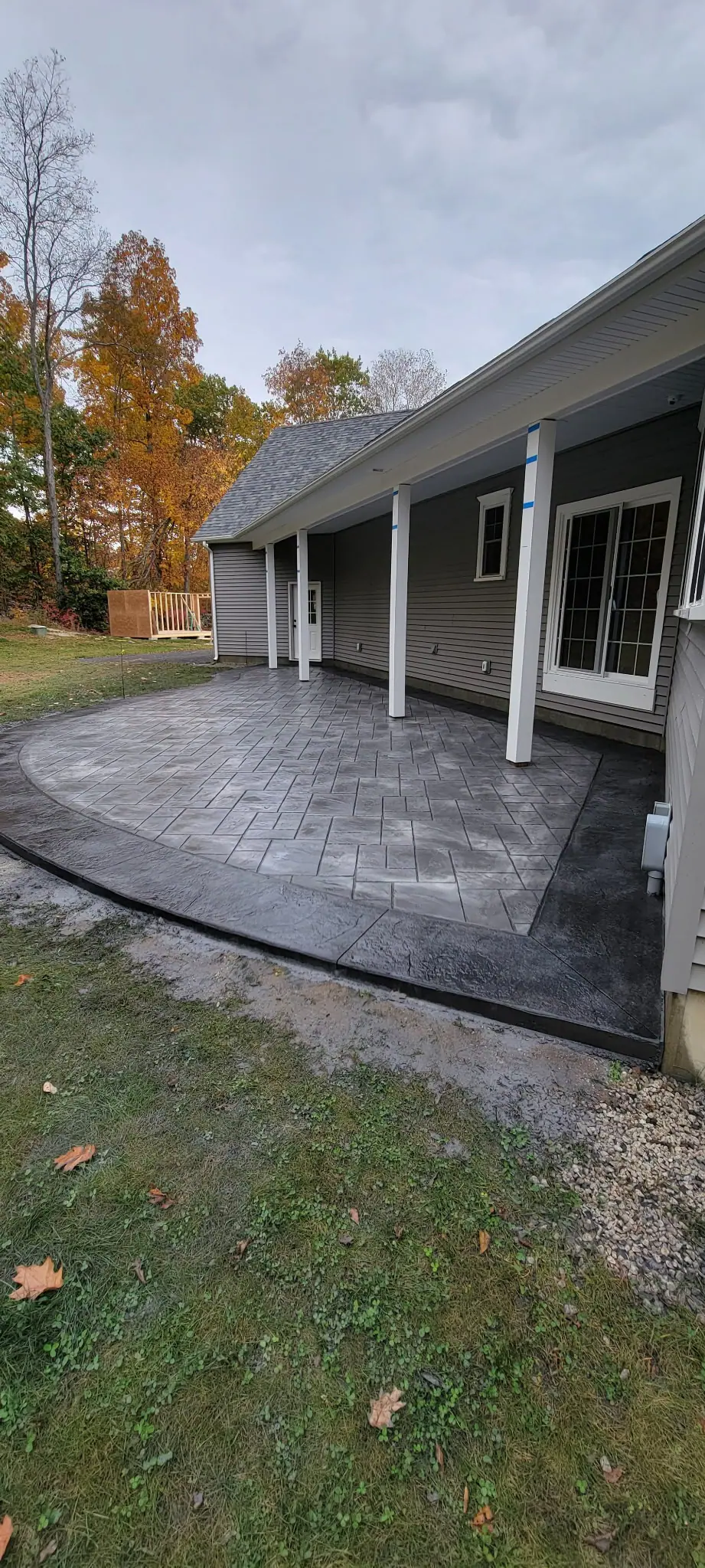
What Is a Stamped Concrete Patio?
A stamped concrete patio is a poured concrete slab that has a pattern and texture pressed into its surface while the concrete is still fresh, then colored to mimic natural materials. The result looks like cut stone, brick, slate, cobblestone, or even weathered wood plank — but it’s a single, continuous, structurally sound slab underneath. You get the look you want on top and the strength and longevity of concrete below.
The decorative finish is built in three layers: a base color mixed into or hardened onto the concrete that sets the overall tone, an accent (or “antiquing”) color worked into the texture to add depth and a natural, weathered variation, and a protective sealer that locks in the color and shields the surface. Done well, the effect is genuinely hard to distinguish from natural stone at a glance — which is exactly why it appeals to homeowners who want a refined, designed backyard without a stone mason’s price tag.
If you want the broader overview of finishes and how stamping fits alongside our other decorative work, our stamped concrete services page walks through the options, and the projects gallery shows finished installs across the area.
Why a Stamped Concrete Patio Works So Well in the Rochester, NH Climate
A patio in New Hampshire isn’t judged in July. It’s judged in March, after a winter of freeze-thaw, road-salt runoff, and snow load. Rochester and the surrounding Seacoast towns see roughly 50 to 70 freeze-thaw cycles every winter — each one an opportunity for water to seep into a surface, freeze, expand, and pry it apart. That single fact decides whether a decorative patio is a smart investment or a future headache, and it’s where a properly built stamped concrete patio has a real edge.
- Fewer joints than pavers. A stamped patio is one continuous slab, so there are no dozens of individual unit edges for water to penetrate, weeds to colonize, or frost to heave one piece at a time. Fewer joints means fewer failure points through a NH winter.
- Air-entrained concrete. The right mix for outdoor flatwork here contains microscopic air pockets that give freezing water somewhere to expand without cracking the slab. This is the single most important spec for freeze-thaw durability — and it’s non-negotiable on every patio we pour.
- A real base and drainage. A compacted crushed-stone base sized for frost, graded so water drains away from the slab and the house, is what keeps a patio from settling and cracking. The stamp is the last thing that matters if the base is wrong.
- A quality sealer. The sealer repels water and de-icers, protects the color, and reinforces the surface against scaling. It’s also the part that needs periodic renewal — more on that below.
In other words, a stamped concrete patio isn’t just a prettier surface — built correctly for this climate, it’s a more durable one. The failures people worry about (scaling, spider cracks, faded color) almost always trace back to a corner-cut install, not to stamped concrete as a material. We cover the same freeze-thaw logic from the repair side in our guide to spring concrete repair in Rochester, NH.
Stamped Concrete Patio Patterns and Colors
The pattern and color are where a stamped concrete patio becomes your patio. The goal is always the same: choose a look that complements the architecture of the home rather than competing with it. Here are the patterns we install most often in the Rochester, NH area and the kind of home each one tends to suit.
Ashlar Slate Most requested
Clean, rectangular cut-stone tiles in a structured layout. Ashlar slate is the most popular stamped concrete pattern we install because it reads as upscale, timeless natural stone, works with both traditional New England and modern homes, and hides minor surface variation beautifully. If you’re not sure where to start, this is the safe, high-end default.
Random Stone & Fieldstone Natural look
Irregular, organic shapes that mimic hand-laid fieldstone or flagstone. This pattern gives the most natural, less “manufactured” appearance and looks especially at home with rustic, farmhouse, and wooded-lot properties common around Strafford County. It pairs well with multi-tone earth coloring for depth.
Herringbone & Running-Bond Brick Classic
The warm, traditional look of a brick patio — without the dozens of joints, the weeds between them, or the individual bricks that heave and settle over a NH winter. Herringbone brick is a strong choice for classic colonials and homes with existing brick accents, and it carries beautifully from a patio into a matching walkway or front entry.
Large-Format Flagstone High-end
Oversized, irregular stone slabs that create a relaxed, luxurious patio surface. Large-format flagstone is a favorite for entertaining spaces and pool surrounds where homeowners want an open, resort-style feel. It’s a standout pattern for a backyard built around hosting.
Weathered Wood Plank On-trend
A newer, increasingly requested look that mimics wide wood planks — the warmth of a wood deck with none of the rot, splinters, staining, or annual sealing a real deck demands in the New England climate. It’s a smart fit for modern and transitional homes that want texture without maintenance.
On color, the most durable, timeless results come from a base tone drawn from natural stone — warm tans and buffs, cool grays and charcoals, or earthy browns — with a complementary accent color antiqued into the texture so the surface has depth instead of looking flat and painted. We always recommend selecting your pattern and color against the actual house: the siding, roof, trim, and any existing brick or stone. We bring physical samples to every consultation so you can see and feel the real texture and color in daylight before a single yard of concrete is ordered.

How Much Does a Stamped Concrete Patio Cost in Rochester, NH?
Cost is usually the deciding question, so here’s the honest local picture. In the Rochester, NH area, most stamped concrete patios run roughly $18 to $30 per square foot installed. A plain, broom-finished patio typically runs $10 to $15 per square foot, so stamping adds a premium for the decorative finish — but it still comes in well below natural stone or high-end pavers while delivering a comparable high-end look.
| Patio type | Typical installed cost (Rochester, NH) | Best for |
|---|---|---|
| Plain broom-finished concrete | $10–$15 / sq ft | Budget-focused, utilitarian surfaces |
| Single-color stamped concrete | $15–$22 / sq ft | A decorative upgrade at a sensible price |
| Multi-color / premium stamped | $22–$30+ / sq ft | High-end, custom backyard living spaces |
| Natural stone or premium pavers | $30–$50+ / sq ft | Comparison point — the look stamped concrete imitates |
For a typical 400-square-foot backyard patio, that usually puts a quality stamped concrete patio somewhere in the $7,000 to $12,000 range. The factors that move a real quote up or down are consistent:
- Size and layout complexity. Larger patios cost less per square foot; curves, multiple levels, borders, and inlays add labor.
- Pattern and number of colors. A single-color ashlar slate is more economical than a multi-tone, bordered design with an accent band.
- Site prep and access. Removing an old slab, building up a base on a sloped or wet lot, or limited equipment access all add cost.
- Base and drainage requirements. Proper frost-depth base and grading isn’t where you save money in NH — it’s what protects the whole investment.
For a deeper line-item breakdown of how patio pricing comes together locally, see our full concrete patio cost in Rochester, NH guide. And because timing affects both price and quality, our best time to pour concrete in New Hampshire calendar explains why the prime-season pour also gives the cleanest stamped finish.
Curious what a stamped concrete patio would cost for your backyard? A 20-minute on-site walk-through is usually all it takes for a clear, written quote and a real design direction. Free, no-pressure estimates across Rochester, Dover, Somersworth, Durham, Farmington, Barrington, and surrounding NH towns.
Stamped Concrete vs. Pavers for a NH Patio
It’s the most common comparison homeowners ask us to settle, and the honest answer is that both materials work in New Hampshire — the right call depends on your priorities. Here’s the short version:
- Seamless look: Stamped concrete wins. A continuous slab reads cleaner and more designed than a field of individual units.
- Up-front cost: Stamped concrete is usually the better value, generally coming in below quality pavers for a comparable look.
- Day-to-day maintenance: Stamped concrete wins — no joint sand to replenish and far less weeding.
- Spot repairs: Pavers win here. An individual unit can be lifted and reset or swapped; concrete repairs are patched or resurfaced.
- Freeze-thaw movement: A properly based stamped slab resists heaving as a unit, while pavers can shift individually — though a quality paver base mitigates this.
For most homeowners who want a high-end, low-maintenance patio at a sensible price, stamped concrete is the stronger overall value. But we’ll always tell you straight when pavers are the better fit for your specific site. We break the whole comparison down in detail in stamped concrete vs. pavers: which is better for New England homes?
Designing Your Outdoor Living Space Around a Stamped Patio
The homeowners who get the most out of a stamped concrete patio think of it as an outdoor room, not just a slab to set a grill on. A little design intention up front turns a patio into the part of the house everyone gravitates to from late spring through fall. A few ideas worth planning into the pour:
- Define zones. A dining area near the door, a lounge or fire-pit area beyond it, and a clear path between them. Stamping lets you shift pattern or color subtly to separate zones without breaking the surface.
- Add a contrasting border. A soldier-course brick or stone border around an ashlar or flagstone field frames the patio and looks custom — a small upgrade with an outsized visual payoff.
- Connect the spaces. Carry the same pattern into a walkway, a front entry, or a pool patio so the whole property reads as one cohesive, intentional design.
- Plan for furniture and fire. Size the patio for the table, chairs, and clearance you actually want — and decide on a fire pit or built-in seating early, so the layout and any footings are right from day one.

How Long Does a Stamped Concrete Patio Last? Care & Maintenance
A properly installed stamped concrete patio in New Hampshire will last 25 to 30 years or more. The structural slab is the part that lasts the longest; the decorative surface — the color and the sealer — is the part that benefits from light, periodic upkeep. The good news is that the routine is genuinely simple, and it’s a big reason homeowners choose stamped concrete in the first place:
- Clean it once or twice a year. Sweep or rinse off debris as needed, and give it a deeper clean with a mild cleaner and a soft brush or low-pressure rinse seasonally. No joint sanding, no weeding.
- Reseal every 2 to 3 years. This is the one maintenance item that matters. A fresh coat of quality sealer renews the color, repels water and de-icers, and keeps the freeze-thaw resistance intact. Skipping it for years is the most common reason a stamped patio starts to look tired.
- Go easy on de-icers, especially the first winter. Harsh salts are hard on any concrete surface. Use them sparingly, choose a concrete-safe de-icer, and let the slab get through its first full winter before any heavy salt exposure.
- Shovel smart. Use a plastic-edged shovel rather than a metal one to protect both the texture and the sealer through the snow season.
That’s the entire maintenance picture: clean it, reseal it every couple of years, and treat it kindly in winter. The same freeze-thaw and de-icer principles apply to driveways, which we cover in our New Hampshire winter driveway maintenance guide.
A stamped concrete patio isn’t just a one-time purchase — it’s a 25-year investment in how you use your backyard. The install decides how good it looks on day one; the base, the mix, and a sealer every few years decide how good it looks on day 3,650.
What a Quality Stamped Patio Install Actually Looks Like
Almost every stamped concrete patio that fails early fails for the same reason: the visible finish was treated as the whole job, and the unglamorous fundamentals underneath were rushed. After more than 10 years pouring in this climate, here is the standard we hold every stamped patio to — and the checklist worth holding any contractor to before you sign:
- Compacted, frost-appropriate base. A properly graded and compacted crushed-stone base sized for New Hampshire frost, sloped to drain water away from the slab and the home.
- Air-entrained concrete mix. Spec’d for outdoor flatwork in a freeze-thaw climate — the microscopic air pockets are what let the slab survive 50-plus freeze-thaw cycles a winter.
- Reinforcement. Fiber mesh or a rebar grid sized to the slab’s use, so the concrete resists cracking under load and movement.
- Saw-cut control joints. Placed at correct intervals and depth so any shrinkage cracking happens where it’s planned and stays invisible — integrated thoughtfully into the stamped pattern.
- Proper color and stamping in the finishing window. Base color, then a clean, crisp stamp pressed in the tight window where the slab is firm enough to hold the pattern but soft enough to take it, then antiquing for depth.
- Correct curing and a quality sealer. Controlled curing, then a sealer to protect the color and surface through that critical first NH winter.
None of this is exotic — it’s simply the difference between a patio that still looks custom in a decade and one that scales and fades in three winters. You can read more about how we approach the work on our about page, and see finished installs on the projects page.
When Is the Best Time to Install a Stamped Patio in NH?
The best window to pour and stamp a patio in New Hampshire is the prime season of late May through late September, with June and September ideal. Stamping is finish-dependent work: it needs that tight window where the slab is firm enough to hold a crisp pattern but soft enough to take the texture, and that window is widest and most forgiving in mild, settled weather. Because the prime months book up quickly, the best time to call is late winter or early spring to lock in an in-season install date. Our full month-by-month NH pour calendar breaks down exactly why timing matters for finish quality.
Why Rochester Homeowners Choose Patriot Concrete for Stamped Patios
A stamped concrete patio is part craftsmanship and part design judgment, and both come from doing the work, in this climate, for years. Homeowners across the Rochester, NH area choose Patriot Concrete because:
- Over 10 years of local experience pouring and stamping outdoor concrete that’s built specifically for New England freeze-thaw — not generic flatwork.
- Durable craftsmanship first. We build the base, mix, reinforcement, and joints right, so the beautiful finish has something solid to sit on for decades.
- Honest, clear communication. A real written scope, straight pricing, samples you can see before you commit, and an honest recommendation — including when a different surface is the better call for your site.
- A genuinely local contractor. We serve Rochester and the surrounding Strafford County and Seacoast NH communities, and we stand behind the work in the towns where we live and pour.
Browse our finished work on the projects page, see the full list of finishes on our services page, or read more about our stamped decorative concrete work.
Frequently Asked Questions: Stamped Concrete Patios in Rochester, NH
How much does a stamped concrete patio cost in Rochester, NH?
In the Rochester, NH area, most stamped concrete patios land between roughly $18 and $30 per square foot installed, depending on the pattern, number of colors, site prep, and layout complexity. A plain broom-finished patio runs $10 to $15 per square foot, so stamping adds a premium for the decorative finish — while still costing far less than natural stone or high-end pavers. For a typical 400-square-foot patio, that usually puts a quality stamped patio in the $7,000 to $12,000 range. The honest number for your project depends on access, base conditions, and design, which is why we walk every site before quoting.
Does stamped concrete hold up to New Hampshire winters?
Yes — when it’s built correctly. The Rochester, NH area sees 50 to 70 freeze-thaw cycles each winter, so a stamped patio that lasts has to be poured with an air-entrained mix, a compacted and well-drained crushed-stone base, correct reinforcement, saw-cut control joints, and a quality sealer. Built that way, a stamped patio handles New England freeze-thaw for decades. The failures you see — scaling, spider cracking, color loss — almost always trace back to a corner-cut install, not to stamped concrete as a material.
What are the most popular stamped concrete patterns?
The most popular stamped concrete patterns for New Hampshire patios are ashlar slate (a clean, rectangular cut-stone look), random or irregular fieldstone, herringbone and running-bond brick, large-format flagstone, and weathered wood plank. Ashlar slate is the most requested because it reads as upscale natural stone, complements both traditional and modern homes, and hides minor surface variation well. Pattern choice is usually driven by the style of the home — we bring physical samples so you can see the texture and color in person before anything is poured.
Is stamped concrete better than pavers for a patio in NH?
Both work well here, and the right answer depends on your priorities. Stamped concrete is poured as one continuous slab, so it has far fewer joints than pavers — fewer places for weeds, fewer units to shift or heave in freeze-thaw, and a cleaner, more seamless look. It’s usually less expensive than quality pavers and lower-maintenance day to day. Pavers have the advantage that individual units can be lifted and reset, and a damaged unit can be swapped out. For most homeowners who want a high-end, low-maintenance patio at a sensible price, stamped concrete is the stronger value — but we’ll tell you honestly when pavers fit your site better.
How long does a stamped concrete patio last?
A properly installed stamped concrete patio in New Hampshire will last 25 to 30 years or more. The structural slab lasts the longest; the decorative surface — the color and sealer — needs periodic maintenance to stay looking its best. Plan to reseal every 2 to 3 years to protect the color, repel water and de-icers, and keep the freeze-thaw resistance intact. With routine resealing and basic cleaning, a stamped patio holds its finish and color for decades.
How do you maintain a stamped concrete patio?
Stamped concrete is low-maintenance, not no-maintenance. Sweep or rinse off debris as needed, clean it once or twice a year with a mild cleaner and a soft brush or low-pressure rinse, and reapply a quality sealer every 2 to 3 years. In winter, avoid harsh de-icing salts — especially the first winter — and use plastic shovels rather than metal-edged ones to protect the surface and sealer. That’s essentially the entire routine, and it’s a big part of why homeowners choose stamped concrete.
When is the best time to install a stamped concrete patio in NH?
The best time to pour and stamp a patio in New Hampshire is the prime season of late May through late September, with June and September ideal. Stamping requires a tight finishing window where the slab is firm enough to hold a crisp pattern but soft enough to take the texture, and that window is widest in mild, settled weather. Because the prime months book up fast, the best time to call is late winter or early spring to lock in an in-season install date for your Rochester, NH patio.
Can you stamp an existing concrete patio?
You can’t stamp a patio that’s already cured — the pattern has to be pressed into fresh concrete during the pour. However, an existing patio in sound condition can sometimes be resurfaced with a stampable overlay that bonds to the old slab and takes a pattern and color. Whether an overlay is the right move depends on the condition of the existing slab: if it’s cracked, heaving, or has a failing base, a tear-out and fresh stamped pour is usually the better long-term investment. We assess the existing slab on site and give you a straight recommendation.
Ready to Design Your Stamped Concrete Patio?
Whether you’re picturing an ashlar slate patio for entertaining, a herringbone brick space off the kitchen, or a flagstone surround that ties the whole backyard together, we’ll walk the site, bring samples, write a clear scope, and tell you straight what the right pattern, layout, and budget look like for your home. Reach out through our contact page, email patriotconcrete603@gmail.com, or call (603) 312-8284 for a free on-site estimate from a stamped concrete contractor that pours this climate every season.


