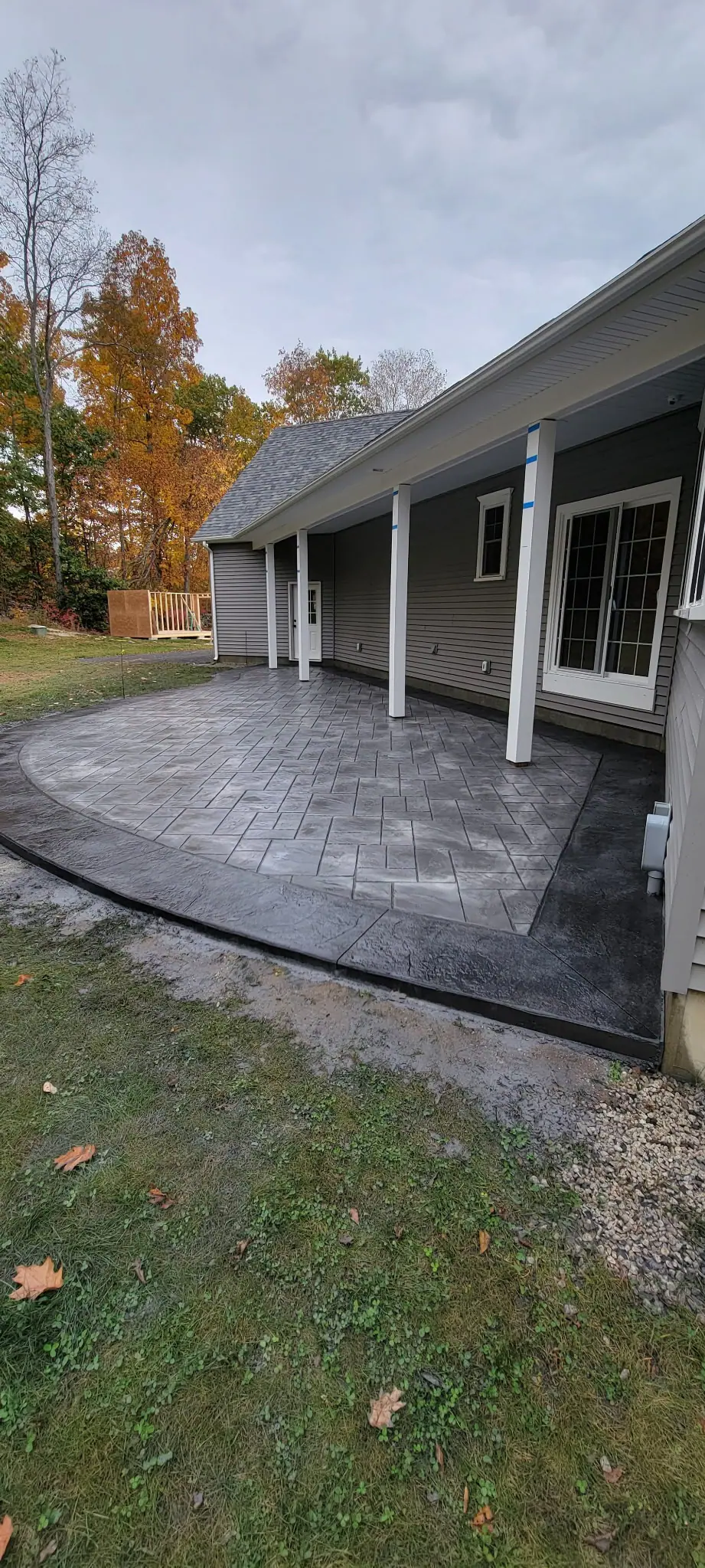
When a homeowner in Rochester or anywhere else in New Hampshire starts planning a new patio, walkway, or pool deck, the decision almost always comes down to two finalists: stamped concrete or paver blocks. Both can look beautiful, both can last decades, and both have real tradeoffs. This guide is the honest side-by-side we give our clients when they ask which one is actually right for their property.
Quick verdict: how they compare at a glance
If you just want the summary before reading the detail, here it is:
| Factor | Stamped Concrete | Pavers |
|---|---|---|
| Installed cost (NH) | $14–$22 / sq ft | $18–$30 / sq ft |
| Lifespan (well-installed) | 25–50 years | 25–50 years |
| Freeze-thaw durability | Excellent when sealed & air-entrained | Good, but joints are weak points |
| Maintenance cadence | Reseal every 3–5 years | Resand & spot-level every 3–5 years |
| Repairability | Patch / overlay (pattern match varies) | Individual pavers lift and replace |
| Weed / moss growth | None (single surface) | In joints; ongoing management |
| Snow plow / shovel friendliness | Smooth; easy | Blade can catch joint edges |
| Design flexibility | Continuous pattern, custom colors | Modular patterns, borders |
Stamped concrete wins on cost, winter maintenance, and uninterrupted design. Pavers win on modular repair and a certain kind of traditional New England aesthetic. Most of the remaining decision comes down to what the rest of your property looks like and how you want to spend your weekends.
What stamped concrete actually is
Stamped concrete is poured as a single slab, then textured and colored while the concrete is still plastic. Specialized mats press patterns into the surface to mimic stone, brick, slate, wood plank, or cobblestone, and integral color plus release agents produce the final look. Once cured and sealed, the result is a continuous, durable surface that reads visually as masonry but behaves as a monolithic concrete slab.
The key thing to understand is that quality stamped concrete is a craft product. The base prep, air entrainment percentage, control joint placement, stamp timing, and sealer choice all affect how it looks ten years later. A bad stamp install looks bad fast; a well-done one looks nearly identical to high-end stone.

What pavers are (and the two main types)
Pavers are individual units set on a compacted base with sand-filled joints between them. There are two categories worth understanding before you get quotes:
Concrete pavers
Mass-produced concrete blocks in a variety of shapes, sizes, and colors. More affordable than natural stone, reasonably uniform, and widely available. Most residential paver patios in the seacoast region are this category.
Natural stone pavers
Bluestone, granite, fieldstone, or cut stone — quarried rather than manufactured. More expensive, often irregular, and highly authentic for colonial and farmhouse-style New England homes. Install labor is higher because the pieces don’t fit as uniformly.
Cost comparison in New Hampshire
Installed prices in our region as of recent projects:
- Stamped concrete: typically $14–$22 per square foot installed, depending on pattern complexity, color variation, and base prep requirements. Borders, multi-color stamping, or saw-cut detailing push the upper end.
- Concrete pavers: typically $18–$26 per square foot installed. Premium patterns (herringbone, circles, multi-size) push to the higher end.
- Natural stone pavers: typically $24–$35+ per square foot installed. Bluestone is the common upper end for residential work in our region.
On a 400-square-foot patio, that’s roughly a $2,000–$3,500 premium for standard pavers over stamped concrete, and considerably more for natural stone. For larger jobs — driveways, whole-backyard transformations — the stamped concrete cost advantage grows because a single pour is more efficient than setting thousands of individual units.
Durability in freeze-thaw climates
This is where New Hampshire changes the conversation from the generic paver-vs-stamped debates you’ll read elsewhere. Our 50+ annual freeze-thaw cycles and 48-inch frost line in Strafford County apply pressure to both materials, but in different ways.
How pavers shift and heave
Pavers depend entirely on their base. If the contractor didn’t excavate to the proper depth (typically 10–12 inches of compacted base for a patio, deeper for a driveway), didn’t use the right gradation of processed gravel, or skipped proper compaction in lifts, you will see heaving within a few winters. Frost gets under individual pavers, lifts them, and leaves uneven surfaces that need annual spot-leveling. The joints also trap water, which accelerates the cycle.
Why a properly poured stamped slab resists movement
A single slab with air-entrained concrete (5–7% air content is the NH spec), rebar or fiber reinforcement, and correctly placed control joints spreads stress across the entire surface. Water doesn’t have joints to infiltrate. Sealed surface drastically reduces absorption. The failure mode for a well-poured stamped slab is usually a hairline surface crack along a control joint — cosmetic rather than structural.
The caveat: a poorly poured stamped slab in our climate fails fast. Under-cured concrete, missing air entrainment, or sealer applied too early will cause visible damage within 2–3 winters. The material isn’t forgiving of corner-cutting.
Weighing the two for your own project? We’ll walk the space with you and give you a straight answer on which option fits your property and budget — even if the answer is pavers. Free estimates across Rochester, Dover, Somersworth, Portsmouth, and surrounding NH.
Maintenance reality: what you’re signing up for
Both options require attention. Anyone who tells you either one is “maintenance-free” is overselling. The difference is in the type of work.
Stamped concrete maintenance
- Resealing every 3–5 years ($0.50–$1.50 per square foot DIY, more if professional)
- Gentle washing annually with a neutral cleaner
- Avoiding high-concentration calcium or ammonium-based deicers
- Filling any hairline crack before the next winter
Paver maintenance
- Joint sand replacement every 3–5 years (polymeric sand is worth the upgrade)
- Weed and moss treatment 1–2 times per year depending on shade exposure
- Spot-leveling heaved or sunken pavers, usually every 2–3 years
- Full wash and optional resealer every 3–5 years for color preservation
Neither list is crushing, but paver maintenance involves more small recurring tasks, while stamped concrete is essentially a single-weekend job every few years.
Appearance and design flexibility
The right material often depends on what the rest of your home looks like more than any other factor.
Stamped concrete gives you a continuous, unbroken surface that can replicate nearly any natural material. Color variation is applied in multiple layers to mimic real stone. It reads cleanly, modern or traditional depending on the pattern, and plays well with contemporary homes and anything with clean architectural lines.

Pavers give you a modular, slightly more traditional look. The visible joints, small color variation between units, and optional border patterns look right on colonial-era homes, historic properties, and anywhere a slightly informal “old-world” feel suits the architecture. Bluestone in particular is iconic for New England.
Resale value impact
Appraisers in the seacoast NH market value quality hardscape at roughly 50–70% of installed cost. The material used matters far less than installation quality and how well the space fits the home. A beautifully installed stamped patio adds value; a rushed paver install that’s heaving after three winters detracts from it.
If resale is a priority, pick the option that matches the home’s style and invest in quality installation. Don’t let the stamped-vs-pavers debate distract from the more important question: is the person installing it going to do it well.
When pavers are genuinely the better choice
We pour a lot of stamped concrete, but there are real situations where we’ll tell a homeowner to go with pavers instead:
- You plan future utility work under the area. Pulling up pavers to run conduit, a gas line, or irrigation is a one-afternoon job. Cutting into stamped concrete leaves a permanent patch.
- Your home is a historic colonial or farmhouse where bluestone or irregular stone is the architecturally correct choice. Stamped concrete can approximate it, but on a genuinely historic property, real stone is worth the premium.
- You have significant tree roots or soil movement you can’t fully remediate. Pavers can flex and shift without cracking; a solid slab will telegraph any base movement as a crack.
- You want to phase the project over multiple seasons. Pavers are trivially expandable — you can add a section next year and have it match. Stamped concrete additions are harder to blend.
The right answer isn’t always the one a concrete contractor is going to push for. We’d rather refer you to a paver specialist than pour a slab on the wrong property.
If you’re closer to the stamped concrete end of the decision, our stamped concrete service page covers pattern and color options in more detail. If winter care is front of mind, our winter driveway maintenance guide walks through everything stamped concrete needs to get through a NH winter.
Frequently asked questions
Is stamped concrete cheaper than pavers?
In most New Hampshire markets, installed stamped concrete runs $14–$22 per square foot and installed pavers run $18–$30 per square foot, so stamped concrete is typically 20–35% less expensive up front. The gap narrows on small projects under 200 sq ft and widens on larger patios and driveways where stamped concrete’s single-pour efficiency pays off.
Which holds up better to New England freeze-thaw?
A properly poured, air-entrained, sealed stamped concrete slab generally resists freeze-thaw damage better because it’s a single connected surface with no joints for water to infiltrate. Pavers can heave or shift if the base wasn’t prepped to NH frost depth (roughly 48 inches in Strafford County), and the sand-filled joints between pavers are vulnerable to weed growth, erosion, and water intrusion year after year.
Can pavers be repaired more easily than stamped concrete?
Yes — this is one of pavers’ genuine advantages. A single damaged paver can be lifted out and replaced in an hour. Damage to stamped concrete usually requires patching (which rarely matches the original pattern) or overlay of the affected area. If you expect to make utility changes under the patio area, pavers are often the smarter choice.
How long does stamped concrete last compared to pavers?
Both can last 25 to 50 years when installed correctly. Pavers often look worse sooner because of joint weed growth, settling, and color fading — issues a good stamped slab avoids. Stamped concrete requires resealing every 3–5 years to preserve color and surface; pavers require resanding and spot-leveling over the same cadence. Neither is truly low-maintenance, but the failure modes are different.
Does one add more resale value in NH?
Appraisers in our region value quality hardscape at roughly 50–70% of installed cost, and the material used matters less than the quality of the installation and the way the space fits the home. A poorly installed paver patio drags value down as much as a poorly poured slab. If resale is a priority, pick the option that matches your home’s style and invest in quality installation either way.