A new driveway, patio, foundation, or stamped walkway is one of the larger investments you’ll make in your property — and unlike paint or flooring, you can’t easily redo it if it’s done wrong. The single biggest factor in whether that surface still looks sharp and holds firm a decade from now isn’t the concrete itself; it’s who you hire to pour it. If you’re trying to figure out how to choose a concrete contractor in Rochester, NH, this is the honest, practical guide we’d give a neighbor: the questions to ask, how to read an estimate, the red flags that should stop you, and what actually separates work that lasts from work that fails its first hard winter. After more than 10 years pouring concrete across Rochester, Dover, Somersworth, Durham, Farmington, Barrington, and the surrounding Strafford County and Seacoast NH area, here’s how to hire with confidence.
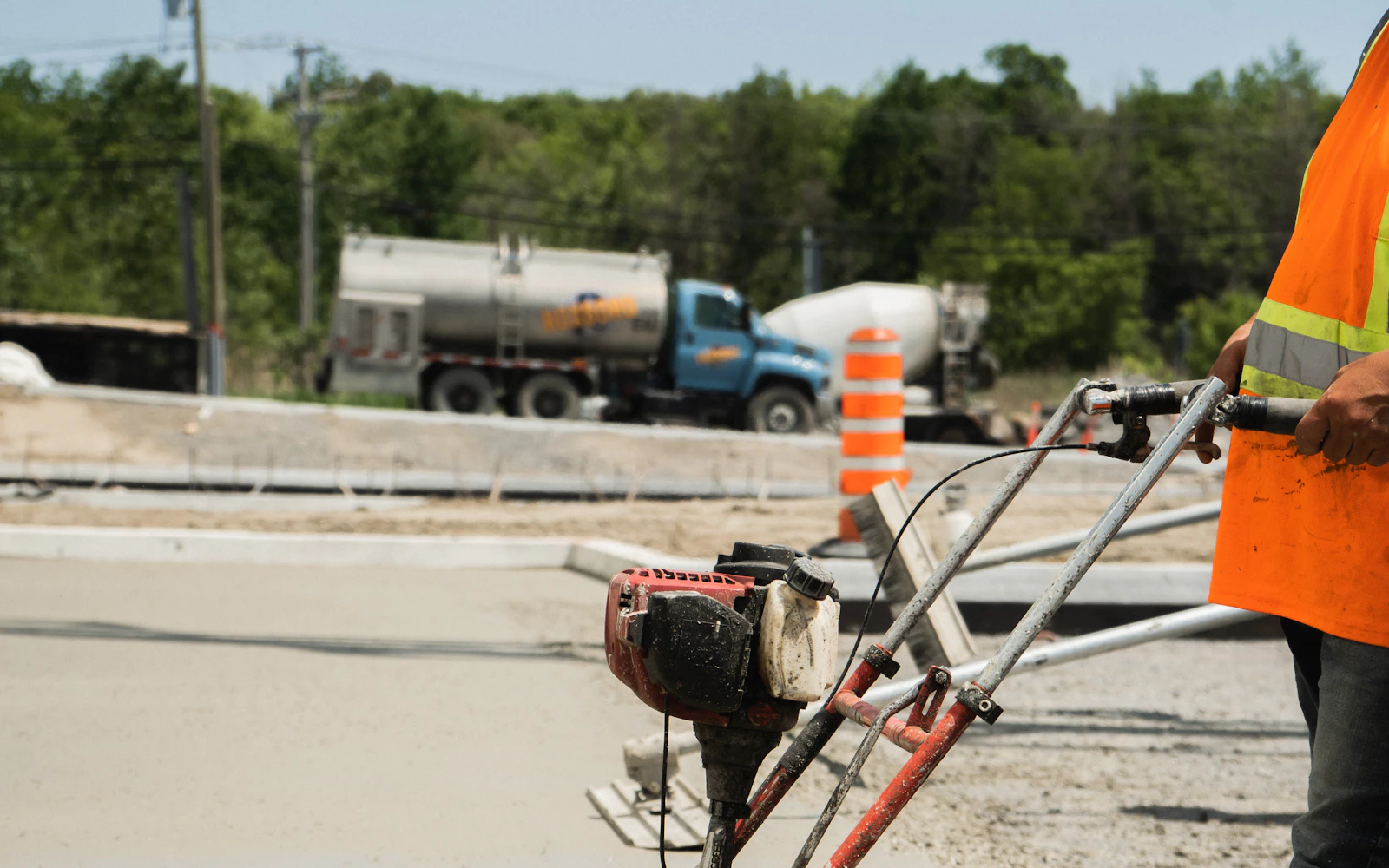
Why Choosing the Right Concrete Contractor Matters More in New Hampshire
In a warm, dry climate, a lot of concrete mistakes stay hidden for years. In New Hampshire, they don’t. The Rochester area sees roughly 50 to 70 freeze-thaw cycles every winter — each one a chance for water to seep into a slab, freeze, expand, and pry it apart. Add road salt, snow shovels, and plow blades, and our climate becomes a stress test that finds every shortcut a contractor took. That’s why choosing a concrete contractor in Rochester, NH is a higher-stakes decision than it would be somewhere the ground never freezes: the difference between a proper install and a corner-cut one doesn’t show up in July. It shows up in March, at the joints, on the surface, and in a slab that has started to heave.
Most of the homeowners who call us fall into one of three groups, and each has a slightly different priority when hiring:
- New installs. A first driveway, patio, pool patio, or foundation slab — where getting the base and layout right from day one is everything.
- Repairs and restoration. An existing surface that’s cracking, scaling, or heaving, where the real skill is correctly diagnosing whether to repair or replace.
- Decorative upgrades. A stamped or decorative surface where craftsmanship and finish consistency separate a beautiful result from a disappointing one.
Whichever camp you’re in, the vetting process is the same — and it starts with a few non-negotiables.
Start With Licensed, Insured, and Genuinely Local
Before you compare a single price, three things should be true of any contractor on your shortlist. Treat these as pass/fail; if a contractor can’t clear them, the quote doesn’t matter.
Fully insured — and willing to prove it
This is the one that protects you directly. A legitimate concrete contractor carries both general liability insurance (for damage to your property) and workers’ compensation (so you’re not liable if someone is hurt on your property). Ask for current certificates before work starts. New Hampshire doesn’t issue a single statewide concrete license, so a reputable local contractor holds whatever registration or permits your specific project requires and carries full insurance as a matter of course. If someone won’t show proof of insurance, that’s the end of the conversation.
Local, with a real track record here
Concrete is part material science and part local judgment about how a surface will live through New England weather — and that judgment only comes from pouring in this climate, season after season. A genuinely local contractor knows our frost depth, our freeze-thaw rhythm, and the towns they’re working in. They also have to stand behind the work where they live, which is a powerful incentive to do it right. You can read more about how we approach that on our about page, and see finished local installs on the projects page.
Experienced with your specific type of project
A crew that pours flat commercial slabs all day isn’t automatically the right choice for a decorative stamped patio, and vice versa. Make sure their recent work — and ideally photos of it — matches what you’re asking for, whether that’s driveways and patios, stamped and decorative concrete, or basement and structural slabs.
12 Questions to Ask a Concrete Contractor Before You Hire
A confident, experienced contractor will welcome these questions; a risky one will get vague or impatient. You don’t need to be an expert — you just need to hear clear, consistent answers that focus on what happens under the surface, not only how it will look on day one.
- How long have you been pouring concrete in the Rochester / Seacoast area?
- Are you fully insured, and can I see current certificates?
- Who actually does the work — your own crew or subcontractors?
- How deep is the base, and what material do you use? (Frost-appropriate, compacted crushed stone is what you want to hear.)
- Is the mix air-entrained for freeze-thaw? (For outdoor flatwork in NH, it should be.)
- What reinforcement will you use — fiber mesh or rebar — and why?
- Where and how will control joints be cut, and when?
- How will you handle slope and drainage so water sheds off the slab and away from the house?
- Will I get a detailed written estimate and scope of work?
- Do you offer a workmanship warranty, and what does it cover?
- What’s your timeline, and how does weather change it?
- Can you share references or recent local projects like mine?
The goal isn’t to grill anyone — it’s to hear whether they think about concrete the way it needs to be built for this climate. Answers that keep coming back to the base, the mix, drainage, and joints are a great sign. Answers that only ever circle back to the finish and the price are a warning.

How to Read and Compare Concrete Estimates
Once you have two or three quotes, the temptation is to line up the bottom numbers and pick the lowest. Resist it. The most useful thing an estimate tells you isn’t the price — it’s what’s included. Compare the scope line by line, and a suspiciously low bid usually explains itself: something that protects the slab has been thinned out or left off.
A complete, trustworthy concrete estimate should spell out:
| What a real estimate specifies | Why it matters in New Hampshire |
|---|---|
| Square footage & slab thickness | Defines the actual scope and the material you’re paying for. |
| Base depth & material | A frost-appropriate, compacted stone base is what stops heaving and settling. |
| Concrete mix (air-entrained) | The microscopic air pockets are what let a surface survive freeze-thaw. |
| Reinforcement (mesh or rebar) | Controls cracking under load and ground movement. |
| Control joints & finish | Plans where cracks go and how the surface performs when wet or icy. |
| Drainage, cleanup & timeline | Protects the investment and sets clear expectations. |
In the Rochester, NH area, plain broom-finished flatwork typically runs about $8 to $15 per square foot installed, with exposed aggregate, color, and stamped finishes adding a premium. If one bid comes in far below that range, ask exactly what’s different — because the lowest price often becomes the most expensive option when a corner-cut slab has to be torn out and repoured a few winters later. For a deeper breakdown of what drives a real number, our guide to concrete patio cost in Rochester, NH walks through the same factors line by line.
Getting quotes for a concrete project? We’re happy to be one of them. A quick on-site walk-through gets you a clear, written scope you can compare against any other bid — no pressure, no obligation. Free estimates across Rochester, Dover, Somersworth, Durham, Farmington, Barrington, and surrounding NH towns.
What Separates Concrete That Lasts (and How to Spot It)
Almost every slab that fails early fails for the same reason: the visible surface was treated as the whole job, and the unglamorous fundamentals underneath were rushed. When you’re evaluating a contractor, you’re really evaluating whether they respect the parts you’ll never see. Here’s the standard we hold every pour to — and a useful checklist to hold anyone you hire to:
- A compacted, frost-appropriate base. Properly graded and compacted crushed stone, sized for New Hampshire frost and sloped to drain. This is what keeps a slab from settling and heaving.
- An air-entrained concrete mix. Spec’d for outdoor flatwork in a freeze-thaw climate — non-negotiable for any surface exposed to our winters.
- Reinforcement sized to the slab. Fiber mesh or rebar so the concrete resists cracking under load and ground movement.
- Correct slope and saw-cut control joints. The right pitch to shed water, with joints placed at proper intervals so any shrinkage cracking stays hidden in the joint line.
- A traction-first finish. A broom or exposed aggregate finish that stays safe underfoot when wet or icy — never a slick, smooth trowel finish outdoors.
- Proper curing and sealing. Controlled curing, then a quality sealer to protect the surface through that critical first NH winter.
A contractor who leads with these details is telling you they build for the long haul. If you want to understand why the timing of the pour also affects finish quality and durability, our month-by-month NH pour calendar explains it in plain language — and if you’re weighing a repair, our guide to spring concrete repair in Rochester, NH covers how to tell whether a surface can be saved or should be replaced.

Red Flags: Warning Signs of a Concrete Contractor to Avoid
The Rochester area, like anywhere, sees its share of out-of-town crews and door-knockers who chase quick cash and move on — long before their work faces its first winter. You can screen most of them out fast. Any one of the flags below should make you slow down; two or more, and you should keep looking.
“We have leftover concrete from a nearby job” Walk away
The classic door-to-door pitch. Real concrete jobs are measured and ordered for the specific pour — nobody has a truck of quality mix looking for a home. This is a pressure tactic, not a deal.
Large cash up front, or cash only Walk away
A reasonable deposit is normal; demands for a big cash payment before work begins, or refusal to accept traceable payment, are not. It’s a sign a contractor may not be around to finish — or to stand behind — the work.
No written contract, insurance, or local address Serious risk
No scope in writing, no certificates of insurance, no verifiable local presence, and no recent work to point to. Without these, you have no protection and no recourse if something goes wrong.
High-pressure, “today only” pricing Serious risk
A quality contractor wants you to compare estimates and make a confident decision. Manufactured urgency exists to stop you from doing exactly that.
A quote that only describes the finish Ask more
If the estimate talks about color and stamping but says nothing about base depth, mix, reinforcement, or joints, the most important parts of the job are undefined — and undefined usually means minimized.
Match the Contractor to Your Project — and Plan the Timing
The “best” concrete contractor is partly a function of what you’re building. Make sure whoever you hire genuinely specializes in your kind of work:
- New installs — driveways and patios, pool patios, walkways, and basement and structural slabs — live or die on base and layout done right from the start.
- Repairs and restoration reward an honest diagnosis. The right pro will tell you when a repair is the smart call and when a tear-out is the better long-term value.
- Decorative and stamped concrete is where finish craftsmanship matters most — ask specifically to see recent stamped work.
Timing matters too. Prime pouring season in New Hampshire runs from late spring through early fall, and good local contractors book those months well ahead. The best time to reach out is late winter or early spring — early enough to compare estimates properly and lock in an in-season date, rather than rushing the decision because you need the work done now. You can see the full range of what we build on our services page.

Why Rochester Homeowners Choose Patriot Concrete
We built this guide the way we’d want to be evaluated — because we’d rather earn a homeowner who did their homework. When you hold us to the standards above, here’s what you’ll find:
- Over 10 years of local experience pouring driveways, patios, pool patios, walkways, foundations, and decorative concrete built specifically for New England freeze-thaw.
- 50+ projects completed and a 5.0 Google rating from homeowners across the Rochester, NH area — work you can see on our projects page.
- 100% locally owned, licensed, and fully insured — we stand behind the work in the towns where we live and pour.
- Durable craftsmanship first. We get the base, mix, slope, reinforcement, and joints right, so the finish has something solid to sit on for decades.
- Honest, clear communication. A real written scope, straight pricing, free estimates, and an honest recommendation — including when a repair beats a replacement.
Choosing a concrete contractor isn’t about finding the lowest number on a page. It’s about finding the person who can tell you, in plain language, what they’re going to bury under your slab — and then does exactly that. Get that part right, and the finish takes care of itself.
Frequently Asked Questions: Hiring a Concrete Contractor in Rochester, NH
How do I choose a good concrete contractor in Rochester, NH?
Choose a concrete contractor the same way you would vet any major home investment: confirm they are local, fully insured, and experienced with New Hampshire’s freeze-thaw climate; ask exactly how they build the base, mix, and joints, not just how the surface will look; get a detailed written estimate that spells out the scope; and check recent local work and reviews. The best contractor is rarely the cheapest or the fastest — it’s the one who can clearly explain what happens under the surface and puts it in writing. In the Rochester area, prioritize a genuinely local contractor who stands behind the work in the towns where they live and pour.
Should a concrete contractor be licensed and insured in New Hampshire?
At a minimum, insist on proof of insurance — both general liability and workers’ compensation — before any work begins, so you are not exposed if there’s property damage or an on-site injury. Licensing requirements vary by town and by the type of project; New Hampshire does not issue a single statewide concrete license, so a reputable local contractor will hold whatever registration or permits your specific job requires and will handle or advise on them for you. If a contractor won’t show current insurance certificates, that alone is a reason to walk away.
What questions should I ask a concrete contractor before hiring?
Ask how long they’ve worked in the area, whether they’re fully insured, and who actually does the pour. Then get specific about the build: What base and how deep? Is the mix air-entrained for freeze-thaw? What reinforcement do you use? How and where will control joints be cut? What’s the drainage and slope plan? Do you offer a written scope and warranty? A contractor who answers these clearly and consistently understands New Hampshire concrete; one who brushes them off or only talks about the finish is a risk.
How do I compare concrete estimates without just picking the cheapest?
Compare estimates line by line, not just by the bottom number. A real quote should spell out square footage and thickness, the base depth and material, the concrete mix and reinforcement, control joints, finish, drainage, and cleanup. If one bid is dramatically lower, it’s almost always because something that protects the slab — base depth, air-entrained mix, reinforcement, or proper joints — has been thinned out or left off. The lowest price often becomes the most expensive option when a corner-cut slab has to be torn out and repoured a few winters later.
How much does it cost to hire a concrete contractor in Rochester, NH?
In the Rochester, NH area, plain broom-finished concrete flatwork typically runs about $8 to $15 per square foot installed, with exposed aggregate and stamped or decorative finishes costing more. The real number depends on size, thickness, site prep, access, drainage, and finish, which is why any honest contractor walks the site before quoting. Focus less on the lowest price and more on what’s included in the scope — a slightly higher bid that specifies a proper base, an air-entrained mix, and reinforcement is usually the better long-term value.
Do I need a permit for concrete work in Rochester, NH?
It depends on the project and where it sits on your property. Simple flatwork replacements often don’t require a permit, while structural work, projects near property lines or setbacks, and anything touching a public sidewalk or right-of-way frequently do. Requirements vary by town, so the safest approach is to confirm with the local building or code office — and a good local concrete contractor will already know Rochester-area requirements and help you handle any permits your job needs. Be wary of any contractor who tells you to skip permits to save time or money.
What are the red flags of a concrete contractor to avoid?
The biggest warning signs are door-to-door solicitation and “we have leftover concrete from a nearby job” pitches, demands for large cash payments up front, no written contract or scope, no proof of insurance, no local address or verifiable recent work, high-pressure “today only” pricing, and a quote that only describes the finish while ignoring the base, mix, and joints. Any one of these is a reason to slow down; two or more, and you should keep looking.
When is the best time to hire a concrete contractor in NH?
Reach out earlier than you think you need to. The prime pouring season in New Hampshire runs from late spring through early fall, and good local contractors book those months well in advance — so the best time to call is late winter or early spring to lock in an in-season date. Planning ahead also gives you time to compare estimates properly instead of rushing the decision because you need the work done right away.
Ready to Talk to a Local Concrete Contractor?
Whether you’re planning a new driveway or patio, weighing a repair, or designing a stamped concrete upgrade, we’ll walk the site, talk through the build in plain language, put a clear written scope on paper, and tell you straight what the right approach and budget look like for your home — so you can compare us honestly against anyone else. Reach out through our contact page, email patriotconcrete603@gmail.com, or call (603) 312-8284 for a free on-site estimate from a concrete contractor that pours this climate every season.


